
Osler is bringing Downhill Back to the Escarpment
Set against the Niagara Escarpment near Collingwood, Ontario, Osler Bluff Ski Club has long been a place shaped by winter. Ski runs cut down the slope, and for generations the rhythm of the club has followed snow.
But winters are getting shorter, and Osler is looking beyond them.
Mountain biking, and a growing network of Osler Bluff trails, is becoming part of that answer.
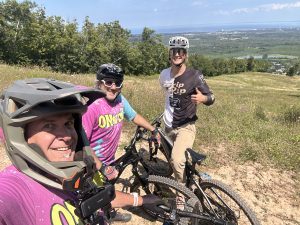
On a hot summer morning in August, we met trail builder Conor Bruno in a sparsely filled parking lot. We spent the day learning how Osler hopes to make that lot considerably busier beyond ski season. We loaded the bikes onto the side-by-side and climbed aboard, headed first for the skill development zone near the bottom of the hill.
It is a compact collection of pump track, flow trail and progressive jumps positioned close enough to the club that parents can sit nearby while kids circle back for another lap. It is also where Osler starts almost everyone—from youth camps to adult clinics.
That emphasis on progression would come up again and again over the course of the day.
The mountain bike network itself is new. Conor says the first major push came during the 2024–25 season, beginning with the skills area and expanding onto the hill with a multi-use climb trail and descending trails ranging from green flow to blue tech and a double-black line.
The idea, however, had been sitting in the landscape much longer.
Conor grew up riding the downhill trails at nearby Blue Mountain. He remembers counting down until he turned 13 and could ride there, getting dropped off by his mother and trying to find someone he could tag along with for laps. With Blue Mountain’s gravity trails now gone, he saw both an opportunity and a demand for that style of riding closer to home.
There were even traces of mountain biking at Osler before the current network. Members had built unsanctioned trails and small features in the woods over the years, and Conor says some of those same riders became strong supporters when the club began developing sanctioned trails.
Osler Bluff Mountain Biking: Built for More Than Summer
The move into mountain biking is not simply an attempt to fill the calendar between ski seasons.
The trails are being designed to work with the hill year-round.
Some of the wooded terrain opened for mountain biking doubles as glade skiing in winter. Clearing damaged trees and improving access through those sections can make the terrain safer and more enjoyable when the snow returns. Conor points to ice storms, freeze-thaw cycles and falling trees as part of the reason the bike project gained support inside the club.
That overlap matters as Osler considers what the next decade might look like.
Conor describes the club as increasingly focused on four-season use as winters get shorter, with mountain biking becoming one piece of a broader summer offering.
Later in the day, the conversation turns toward how much land surrounds the existing network and what might come next. Cross-country ski terrain already occupies parts of the property, and Conor says mountain-bike-specific expansion is part of the plan. Osler also has agreements with neighbouring private landowners and has discussed the possibility of helping develop trails on adjoining properties.
For now, though, the focus is very much on what is already under their tires.
Learning the Hill
From the skills zone we climbed higher, moving onto terrain that quickly made one thing obvious: Osler has gravity.
The two sides of the mountain also build differently. Conor describes one side as darker, loamier soil, while the other brings clay, shale and steeper terrain.
On one of the new green flow trails, the grade itself becomes part of the challenge. There are no mandatory jumps and the trail remains open and approachable, but speed builds quickly. Because the club tries to avoid cutting deeply into the ski slopes themselves, some lines have to take more direct routes through the trees. Conor says protecting hill integrity matters, particularly on escarpment terrain where clay and shale can already be prone to movement.
The next blue flow trail feels more purpose-built: long traverses, big berms and a tighter section Conor calls the “toilet bowl,” followed by tree splits, stumps and another catch berm before the trail crosses hiking routes on its way to the bottom.
It is here that Osler’s multi-use reality becomes especially clear. Hiking and biking coexist across the property, and some climbing trails are intentionally multi-directional and shared. Signage and sightlines therefore become part of trail design, not an afterthought.
Progression remains the governing idea. Conor encourages riders to begin in the skills area, move into the Beehive zone and beginner terrain, then work toward the blue technical trails and eventually Big Mac 3A, the double black. Wherever possible, trails include multiple line choices so riders with different abilities can use the same terrain.
That philosophy also shapes how features are tested.
Conor says the best rider on the trail crew should not be the only person evaluating a berm or jump. An advanced rider can compensate for a feature that does not quite work, but a beginner cannot. So the crew looks for feedback across ability levels, using those different reactions to refine shape, flow and placement.
Building and Maintaining the Trails
Osler’s trails are not drawn once and then cut into the hillside.
Conor describes a process of repeated walking, flagging, re-walking and reworking before and during construction. Trail crew, community riders and industry contacts may all be asked to look at a line before machine work begins. Once vegetation is cleared and construction starts, the terrain can force another rethink—a large piece of shale, unexpected drainage or a section that simply rides differently than it looked on foot.
The club is careful about that process partly because machine time and labour cost money. Conor says they may walk a proposed trail repeatedly before committing resources, trying to be sure the line makes sense before excavation begins.
Not everything is machine-built.
On one trail Conor points out that, aside from rollers near the bottom, the entire line was hand cut. Elsewhere, machines allow the crew to build larger, more durable berms far faster than hand tools would allow.
Infrastructure can change the equation again. A ravine or drainage can make a seemingly simple connection expensive very quickly. Conor notes that a bridge alone can easily become a major cost, making site and slope selection central to what gets built and when.
We got a particularly close look at that process when Conor took us onto a trail that was not officially open yet.
The trail was still soft, some of the signage had yet to arrive, and recent rainfall had left sections loose enough that core riders had been brought in to help test and pack it. Conor called the run a “little sneak peek.”
It was less a finished product than a trail still becoming itself.
How to Access the Osler Bluff Mountain Bike Trails
Osler Bluff remains a private club.
Its mountain bike trails are currently open to members and Friends of Osler. Non-members need sponsorship from a current member to sign in and purchase a bike pass.
Organized events create another route in. Conor explains that mountain bike events, specialty races and organized group rides can be opened more broadly, provided participants register, sign the required waiver and pay the applicable event fee.
Racing is still new at Osler. Conor says the club is working toward timed enduro races and looking at an eight-hour relay event for next year, with camping, food, beverages and family activities built around it.
That controlled access places Osler in an unusual position. It is not a public bike park, and it is not trying to operate like one. Growth has to happen within the economics and culture of a private club.
Yet the network is clearly reaching beyond the membership itself.
Conor refers to community effortlessly and repeatedly throughout the day, saying it is a particular focus for both him and the club. With winters getting shorter, Osler is putting more emphasis on four-season use, while the growing mountain bike program is creating opportunities for more trails, events and relationships with the broader riding community. More trails create more riding opportunities, those riders support shops and brands, and stronger local businesses feed back into the mountain bike community.
Building the Place He Wanted as a Kid
At 25, Conor already moves comfortably between skiing, snowboarding and mountain biking.
His trail-building background did not begin with a formal trail company. It began with building terrain-park features, motocross jumps and bike jumps, then learning through riding what makes a feature work. As his own ability progressed into flips and double flips on skis and bikes, he became more interested in shape, placement, speed and progression.
He also grew up in the Blue Mountain era.
That history keeps resurfacing as we ride. Blue shaped his gravity background, but it also seems to inform what he wants Osler to become: somewhere riders can progress from their first laps into genuinely technical terrain without having to leave the hill.
Conor describes inspiration ranging from the jump and flow of Whistler and what Blue Mountain once offered to the technical terrain of Bromont. Osler cannot replicate those places, nor is it trying to. Funding, access and scale are different. But the ambition is to build a network broad enough to touch multiple sides of mountain biking.
At Osler, kids lap the jumps, parents sit nearby. Camps and clinics remain clustered around beginner terrain and shredders are scoping out the freestyle lines.
Conor talks about building the place for the next generation, but also, in a way, for his younger self—the kid who once waited until he was old enough to ride Blue Mountain.
Now he gets to build the jumps.
YOu should include a link to Trailforks
Hey Don,
I’ll link to Trailforks as soon as they start linking to my blogs. lol.